
By Seda Ozdemir Simsek, TPF Earthquake Fund Lead
Over the past three years, I’ve made regular visits to the earthquake-affected regions of Turkiye. These trips, conversations with families, long walks through provisional settlements, and hours spent with local partners have revealed a deeper, often overlooked truth about recovery.
What happens after survival?
In the early days, there was urgency. Needs were immediate and visible—shelter, food, clean water. Communities formed makeshift kitchens, grief etched on every face. But once the dust begins to settle, quieter questions emerge. The questions are no longer about survival, but about how to live.
As one resident in Hatay told me quietly, “We survived the earthquake, but we don’t yet know how we’re supposed to live now.”
That sentence has stayed with me. It reveals what disaster experts often call the “recovery gap”—the uncertain space between surviving and truly living again. The emergency may be over, but the path forward is still unclear. Rubble is cleared, but people remain in limbo—unsure where they will live, how long they’ll wait, or what comes next. The displacement is not just physical; it’s emotional, social, and deeply personal.
If left unaddressed, this gap can harden into long-term instability. When recovery efforts are short-term or disconnected from people’s lived realities, a temporary crisis risks becoming a permanent condition.
Building Forward: A Broader Understanding of Recovery
At Turkish Philanthropy Funds, we came to understand early on that recovery cannot begin and end with emergency aid. It’s a long continuum that must evolve alongside the communities. Closing the recovery gap requires more than rebuilding structures; it requires rebuilding meaning, connection, and opportunity. That’s why, early on, we made a strategic decision to define recovery more broadly.
This is what we call Building Forward.
But what does that mean in practice?
For us, Building Forward is rooted in equity and local leadership. It means creating the conditions that make healing and agency possible—especially for those most affected, and too often excluded, from traditional systems. This includes support for women’s cooperatives, youth-led art spaces, psychosocial support services, and inclusive economic programs, and community hubs where people can gather again.
This work is slow and relational, unfolding in the spaces of daily life—classrooms, kitchens, sports fields, and community centers.
Recovery is not linear and needs to shift over time. That is why our approach is built on sustained partnership—regular dialogue, frequent site visits, and shared reflection throughout implementation. By remaining present and listening closely as realities evolve, we are able to adapt alongside our partners, offering flexibility so programs remain responsive and deeply grounded in community life. Impact, in this context, is not only about delivery; it is about attentiveness.
Where Recovery Truly Happens
In many ways, the most delicate phase of recovery begins now. Immediate relief efforts have wound down, and physical needs are largely met. Yet, beneath the surface, the emotional and social fabric remains fragile. This is where the heart of community-led recovery lies: in supporting people to reclaim everyday life with agency, connection, and dignity.
Every initiative we support at TPF—whether it’s a mental health program, a youth-led art project, or a women’s cooperative—is guided by one question we return to again and again: Does this help people feel more safe, seen, and supported in their everyday lives?
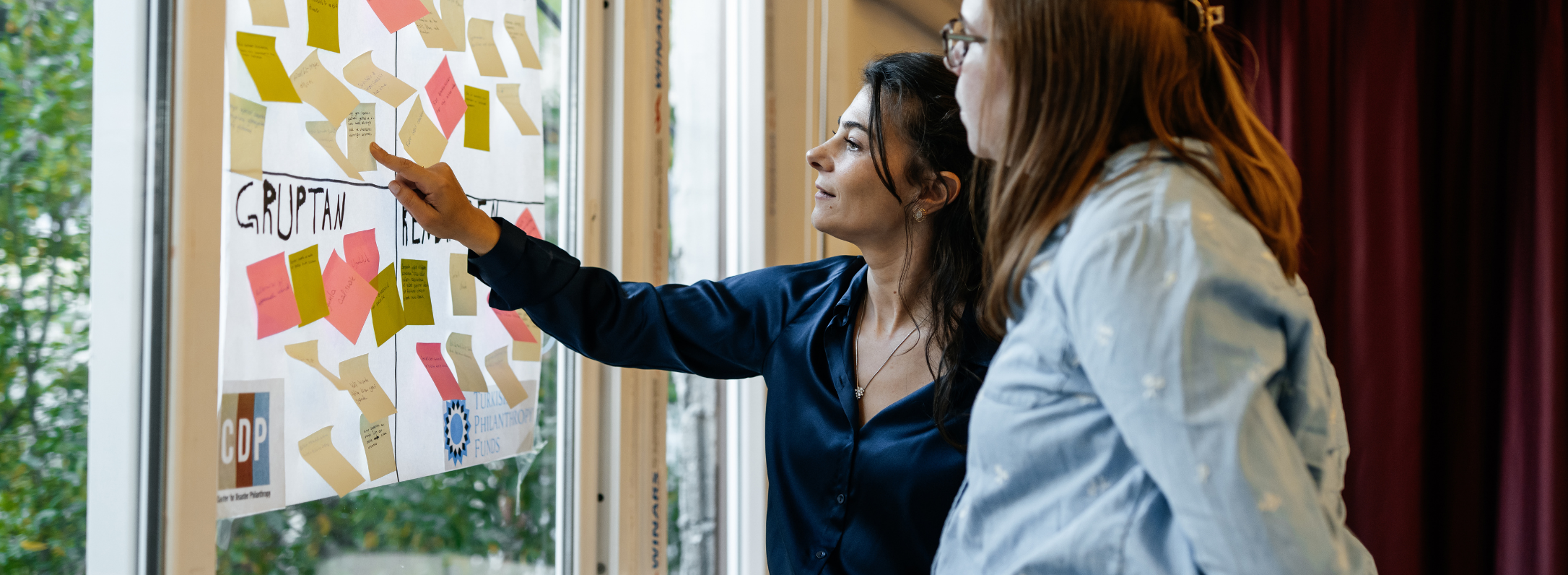
One evening in Hatay, we gathered at the Teachers’ Solidarity Hub—a space created and run by our partner, Teachers Network, with support from TPF and the Center for Disaster Philanthropy. The room was full of energy and quiet resilience as local teachers, members of the Teachers Network team, and colleagues from CDP joined us. Over tea and long conversations, we listened to stories not just about education, but about grief, strength, and rebuilding.
One teacher told me, “I had nowhere to cry alone, so I couldn’t cry.”
Another said simply, “Being here renews my spirit.”
Especially for teachers who came to the region through mandatory placements, this space became more than a professional network. It became a place of emotional safety. Emotional safety is not a luxury, but a foundation from which they can support their students. It is the opportunity to feel useful, to belong, to rebuild identity and relationships in a place that still feels like home.
For many of these people, the question is no longer “what did we lose?” but “who are we now?” as they are rebuilding who they are, what they hope for, and how they belong.
In Samandağ, we saw something similar through the girls’ soccer team at the Samandağ Sports Club. On the surface, it was a sports initiative. In reality, it was a reclamation of space and confidence, and imagining a life beyond survival.
As one of the young girls put it, “Playing football isn’t just about sports, but about being free.” Freedom, in this context, meant imagining a life beyond survival.
Rebuilding Identity Through Work and Community Recovery is often categorized into economic or emotional support. But in practice, the two are inseparable.
Take, for instance, the women of the Rimmen Women’s Cooperative. On one visit, we sat together in their modest workshop—a small but vibrant space filled with the hum of sewing machines, the scent of spices from jars of homemade preserves, and the quiet pride that filled the room. They showed us their work: colorful textiles, carefully labeled jars, handmade crafts.
But what they spoke of most was not the income. They spoke of friendship. Of structure returning to their days. Of laughter. It was the pride of creating something meaningful, of being together, of being seen. As one woman put it, “After the cooperative was founded, I forgot my pain. I turned my grief into creation. Now, I have a purpose again.”
In another neighborhood, we met Gülhan—a mother of four, caring full-time for her visually impaired and chronically ill husband. Her family was at the edge of collapse. With support from our local partner ESYAD, she received both psychosocial support and something simple yet transformative: a sewing machine. It allowed her to earn income without leaving home.
For Gülhan, recovery meant turning the space of caregiving into a space of creation and confidence.
These stories reveal a truth we have witnessed across more than ninety local partnerships over the past three years: recovery is not divided into categories. It is all about rebuilding meaning—helping people feel useful, connected, and seen, in environments they call home.
The Long Arc of Recovery
There will always be another crisis. But whether communities emerge more fragile or more resilient depends on what we choose to invest in now.
If we truly want to “build forward better,” we must center healing, belonging, and community in everything we support. Recovery is not a technical checklist. It is a deeply human journey shaped by quiet resilience, trust, and the courage to imagine a future that doesn’t replicate the past, but reshapes it.
I’ve seen this journey unfold in small, powerful ways. One woman we met through Mavi Kalem’s economic development project captured this spirit with striking clarity:
“I thought I’d never be able to stand again. But I did—because I had to. Starting a business was just an excuse. What mattered was standing back up.”
Community-led recovery is shaped not by blueprints. It unfolds in classrooms, workshops, kitchens, and sports fields. It is shaped by acts of courage and care.
And it is there, quietly, persistently, that long-term recovery truly begins.