

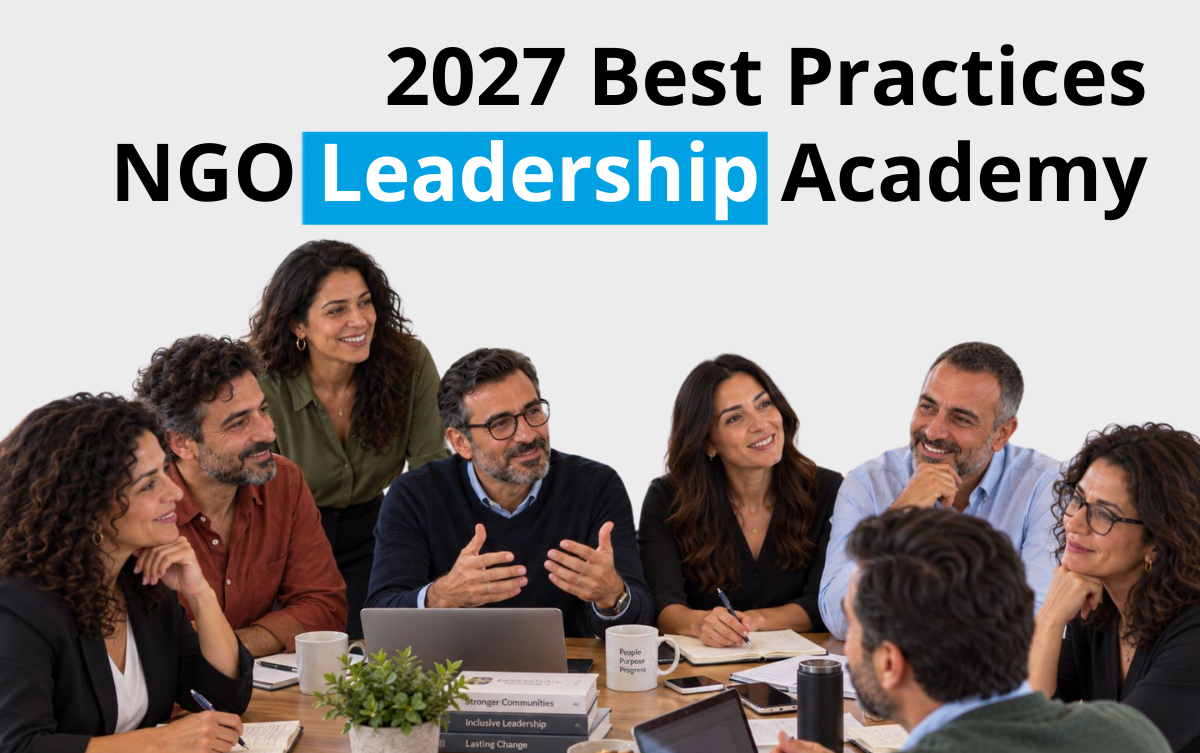
Q&A with Haldun Tashman on Best Practices NGO Leadership Academy
Q: What inspired the idea behind the Best Practices NGO Leadership Academy?
Haldun Tashman: The idea really comes from my own experience in business and from something I have believed for a long time: there is always a better way of doing things, and one of the best ways to improve is to learn from people who are already doing something exceptionally well.
We were in the medical device plastics business in the United States, in a very competitive industry. At one point, I attended a seminar with Dr. W. Edwards Deming, who became famous for his work on quality and management and for helping transform manufacturing practices in Japan. He was already in his 90s when I had the opportunity to hear him. That experience had a tremendous impact on me. It changed the way I thought about management, quality, leadership, and improvement.
Q: What did you take away from Deming’s philosophy?
Haldun Tashman: One of the most important lessons was that quality does not happen simply because people work harder. You have to design systems that help people succeed and that prevent mistakes from happening in the first place. He taught us to look continuously at the system: Where are the problems? Why are they happening? What can we change so they do not happen again?
The idea of continuous improvement stayed with me. You never reach a point where you say, “We are finished. We know everything.” You continue asking: How can we do this better? We brought many of those principles into our own company. In a very competitive industry, we were ultimately able to become one of the leading companies in our field, particularly when it came to quality.
Q: How did learning from others influence the way you ran your company?
Haldun Tashman: I was always looking outside our own company. Who is doing this better than we are? What are they doing differently? What can we learn from them? I would go to Germany, attend trade fairs, visit companies, talk to people, and observe how other organizations operated. Sometimes you discover very simple things that completely change the way you work.
For example, at one point we were operating our facilities five days a week while others in the industry were operating seven days. Simply changing the way we thought about our production schedule gave us the ability to significantly increase capacity. You cannot assume that because you have been doing something one way for many years, it is the best way. Knowledge often comes from outside. That has stayed with me throughout my life.
Q: Why do you think this idea is especially important for nonprofit leaders?
Haldun Tashman: Because the principle is exactly the same. Whether you are running a company, a nonprofit organization, or any institution, you should always be asking: How can we become better at what we do? There are best practices in governance. There are best practices in fundraising, finance, management, communications, transparency, hiring people, developing staff, building trust, and working with your board.
You do not have to discover all of these things yourself. Someone somewhere has already learned something that can help you. The purpose of this Academy is to open that door and give nonprofit leaders an opportunity to learn from experts, from organizations that have developed strong practices, and from one another. “Someone somewhere has already learned something that can help you.”
Q: Why should a nonprofit leader participate in the Academy if they are already experienced?
Haldun Tashman: Because learning has no age. It is a little like an athlete going to a training camp. Even the best athletes continue working with coaches. They continue practicing. They study what other great athletes are doing because they still want to improve. Leadership should be the same.You may already know some of the things your organization needs. Maybe you know you need to improve fundraising, governance, financial management, or communications.
But there are also things you do not yet know that you need to know.That is very important.There are things you are aware you need to learn, and there are things you have not yet discovered. A program like this gives you the opportunity to find both.
Q: What do you hope participants will gain from the Academy?
Haldun Tashman: I hope they leave asking better questions.
How do we gain people’s trust?
How do we become more transparent?
How do we fundraise more effectively?
How do we select and develop good people?
How do we work better with our board?
How do we create systems that allow our organization to grow?
How do we build quality into everything we do?
An organization is made up of many processes. Even something that seems very simple, such as thanking a donor, is part of a larger process. Hiring someone is a process. Training people is a process. Continuing education should be a process. When you start looking at an organization this way, you can begin designing better ways of working rather than simply reacting to problems. My hope is that participants will not only learn new ideas, but will go back to their organizations and put those ideas into practice.
Q: What does “best practices” mean to you?
Haldun Tashman: Best practices does not mean copying someone else.It means looking at people who are achieving excellent results and understanding the principles behind what they are doing. Then you ask: What can I learn from this? How can I apply it to my organization? How can we make it work for us? That is how organizations grow. You look outside. You learn. You adapt. You practice. And then you continue improving. There is always something more to learn and always a better way of doing something.
Q: Why is investing in leadership so important to you?
Haldun Tashman: Giving grants is important. Organizations need financial resources to do their work. But I believe giving people knowledge can be an even greater gift. Money can support a project. Knowledge can change the way someone leads an organization for many years.
If you can help a leader become better at managing people, raising funds, building trust, creating strong systems, or developing the organization, that knowledge continues to create value long after the original investment is made. That is what I hope this Academy can do. We are opening a door. We are bringing knowledge, experience, and people together. What participants do with that opportunity is up to them. But the goal is very simple: Learn from the best. Apply what you learn. And never stop asking, “How can we do better?”
About Haldun Tashman
Haldun Tashman is an entrepreneur, business leader, and philanthropist with a long-standing commitment to education, community building, and strengthening institutions. Born in Bolu, Türkiye, he graduated from Robert College in Istanbul in 1966 and came to the United States as a Fulbright Fellow to attend Columbia Business School. After completing his MBA, he began his career at Deloitte in New York before moving to Phoenix, Arizona, and embarking on his entrepreneurial career.
Tashman became co-owner and manager of The Tech Group, Inc., a plastics contract-manufacturing company serving the pharmaceutical, medical device, consumer products, and personal care industries. Together with his business partner, Steve Uhlmann, he grew the company into an international enterprise with approximately $200 million in annual sales and 12 manufacturing locations across three continents. The Tech Group was acquired by West Pharmaceutical Services in 2005.
Following his business career, Tashman increasingly turned his attention to philanthropy. His own experience with the Arizona Community Foundation introduced him to the potential of the community foundation model: bringing people together around shared needs, creating structures for effective giving, and building institutions that can serve communities over the long term. He and his wife, Nihal, also helped bring that model to Türkiye through the establishment of the Bolu Community Foundation, the country’s first community foundation.
In 2007, Tashman brought that same vision to the Turkish-American community as one of the founders and Founding Chairman of Turkish Philanthropy Funds (TPF). His goal was not simply to create another charitable organization, but to build a trusted platform through which people could come together, give strategically, and strengthen civil society in Türkiye. Today, he serves as Chairman Emeritus of TPF, continuing a relationship with the organization that has spanned nearly two decades.
The Best Practices NGO Leadership Academy reflects the next chapter of that philosophy. Drawing on lessons from a lifetime in business, philanthropy, and institution building, Tashman believes that financial resources alone are not enough to build strong organizations. Leaders also need access to knowledge, effective management practices, new perspectives, and opportunities to learn from those who are doing things well.
Through the Haldun Tashman Fund at TPF, his support of the Academy represents an investment not just in individual nonprofit leaders, but in the long-term strength and effectiveness of civil society in Türkiye.
About the Best Practices NGO Leadership Academy
The Best Practices NGO Leadership Academy is a nine-month leadership development program for nonprofit leaders in Türkiye, created in partnership by Turkish Philanthropy Funds (TPF) and Arizona State University’s Lodestar Center for Philanthropy and Nonprofit Innovation, with support from the Haldun Tashman Fund at TPF.
The Academy brings together a select cohort of nonprofit professionals to strengthen their leadership and organizational capabilities through executive education, peer learning, and practical application. Participants explore areas such as governance, financial management, fundraising, communications, organizational sustainability, and leadership, while applying what they learn to real challenges within their own organizations.
At its core, the Academy is designed around a simple idea: strong organizations are built by leaders who continue to learn, question, improve, and learn from others.
About W. Edwards Deming
W. Edwards Deming was an American statistician, professor, and management thinker whose ideas helped shape modern approaches to quality and organizational improvement. He became especially influential through his work with Japanese industry after World War II and later through his widely known 14 Points for Management. At the center of Deming’s philosophy was the belief that leaders should continually improve the systems in which people work, rather than simply focus on individual errors. His ideas on quality, learning, and continuous improvement influenced organizations around the world.